

SDG 13 Climate Action represents one of the most urgent and complex challenges embedded within the United Nations Sustainable Development Goals, calling for immediate and coordinated efforts to combat climate change and its impacts. This article provides a comprehensive policy framework and actionable roadmap for both national governments and corporate entities, detailing the mechanisms, strategies, and innovations required to meet ambitious global targets. You will gain a thorough understanding of the instruments, regulations, and collaborative actions needed to drive meaningful environmental progress.
In this definitive guide, you will learn:
Read More:
Sustainable Development Goal 13, succinctly titled “Climate Action,” mandates urgent action to combat climate change and its devastating impacts. It is not a standalone environmental concern but a pervasive threat multiplier that exacerbates poverty, disrupts food systems, intensifies resource scarcity, and undermines global stability. The goal’s very existence within the SDG framework underscores that a stable climate is the bedrock upon which all other development goals—from good health and quality education to economic growth and peace—rely. The scientific consensus, most notably articulated by the Intergovernmental Panel on Climate Change (IPCC), leaves no room for ambiguity: human-induced greenhouse gas (GHG) emissions are the dominant cause of observed warming since the mid-20th century, leading to rising sea levels, catastrophic weather events, and irreversible damage to ecosystems.
The core targets of SDG 13, as outlined by the UN, provide a structured blueprint for the global response:
Achieving these targets requires a dual-track approach: Mitigation (reducing the flow of greenhouse gases into the atmosphere) and Adaptation (adjusting to current and expected climate changes). For governments, this translates to sweeping legislative and fiscal reforms. For businesses, it means transforming operational models, supply chains, and investment strategies. Tools like the Climefy Carbon Offset Registry and comprehensive ESG Consultancy are becoming indispensable for organizations navigating this transition, providing the verification and strategic insight needed for credible action. Understanding and implementing SDG 13 is no longer a matter of corporate social responsibility but a fundamental component of long-term viability, risk management, and leadership in the 21st-century economy.
Governmental climate policy is the scaffolding upon which national and international climate action is built. An effective framework is multi-pronged, leveraging regulatory, economic, and informational tools to steer entire economies toward low-carbon and climate-resilient futures. It must be science-based, equitable to ensure a just transition, and enforceable to guarantee real-world impact. The policy mix typically includes market-based mechanisms, direct regulation, public investment, and international cooperation, each playing a complementary role in decarbonizing key sectors like energy, transport, industry, and agriculture.
✔ Carbon Pricing Mechanisms (Carbon Tax vs. Cap-and-Trade): Putting a price on carbon internalizes the external cost of emissions, creating a financial incentive for emitters to reduce their footprint. A carbon tax sets a direct price per ton of CO2e, providing price certainty. A cap-and-trade system (Emissions Trading System – ETS) sets a regulatory cap on total emissions and allows trading of permits, ensuring environmental certainty by limiting total pollution. Over 70 national and subnational jurisdictions have implemented or scheduled carbon pricing initiatives.
✔ Regulatory Standards and Mandates: These are “command-and-control” measures that set specific limits or require the use of certain technologies. Examples include:
✔ Subsidies, Tax Incentives, and Public Investment: Governments can accelerate the transition by phasing out perverse subsidies for fossil fuels and redirecting financial support toward clean solutions. This includes:
✔ Climate Adaptation and Resilience Planning: Policy must address the unavoidable impacts of climate change. This involves:
✔ Support for Innovation and RD&D: Public funding for research, development, and demonstration (RD&D) of breakthrough technologies (e.g., green hydrogen, long-duration energy storage, carbon capture) is crucial to decarbonize hard-to-abate sectors.
✔ International Diplomacy and Finance: Fulfilling commitments under the Paris Agreement, including Nationally Determined Contributions (NDCs), and mobilizing climate finance for developing nations are critical pillars of global policy. Platforms like the Climefy Verified Carbon Standard contribute to this global ecosystem by ensuring integrity in cross-border carbon markets.
For the private sector, climate action has evolved from a reputational concern to a core strategic imperative driven by investor pressure, regulatory compliance, supply chain vulnerabilities, and consumer demand. Corporate climate strategy now rests on two pillars: aggressive decarbonization of the value chain and building operational and financial resilience against physical and transitional climate risks. A robust approach aligns with the Task Force on Climate-related Financial Disclosures (TCFD) recommendations and follows the “mitigation hierarchy”: measure, reduce, then offset residual emissions.
✔ Comprehensive Carbon Accounting and Footprinting: The first non-negotiable step is to accurately measure your greenhouse gas emissions across all three scopes using a standardized framework like the GHG Protocol. This creates a baseline for action. Tools like the Carbon Calculator for Large Organizations or the Carbon Calculator for Small & Medium Companies are essential for this foundational activity.
✔ Science-Based Targets and Net Zero Commitments: Companies are increasingly setting emissions reduction targets aligned with climate science (via the Science Based Targets initiative – SBTi) to limit warming to 1.5°C. A Net Zero Journey involves reducing Scope 1, 2, and 3 emissions by at least 90% and neutralizing the final 10% with permanent carbon removals.
✔ Energy Efficiency and Renewable Energy Procurement: This is the most direct route to reducing Scope 1 and 2 emissions. Actions include:
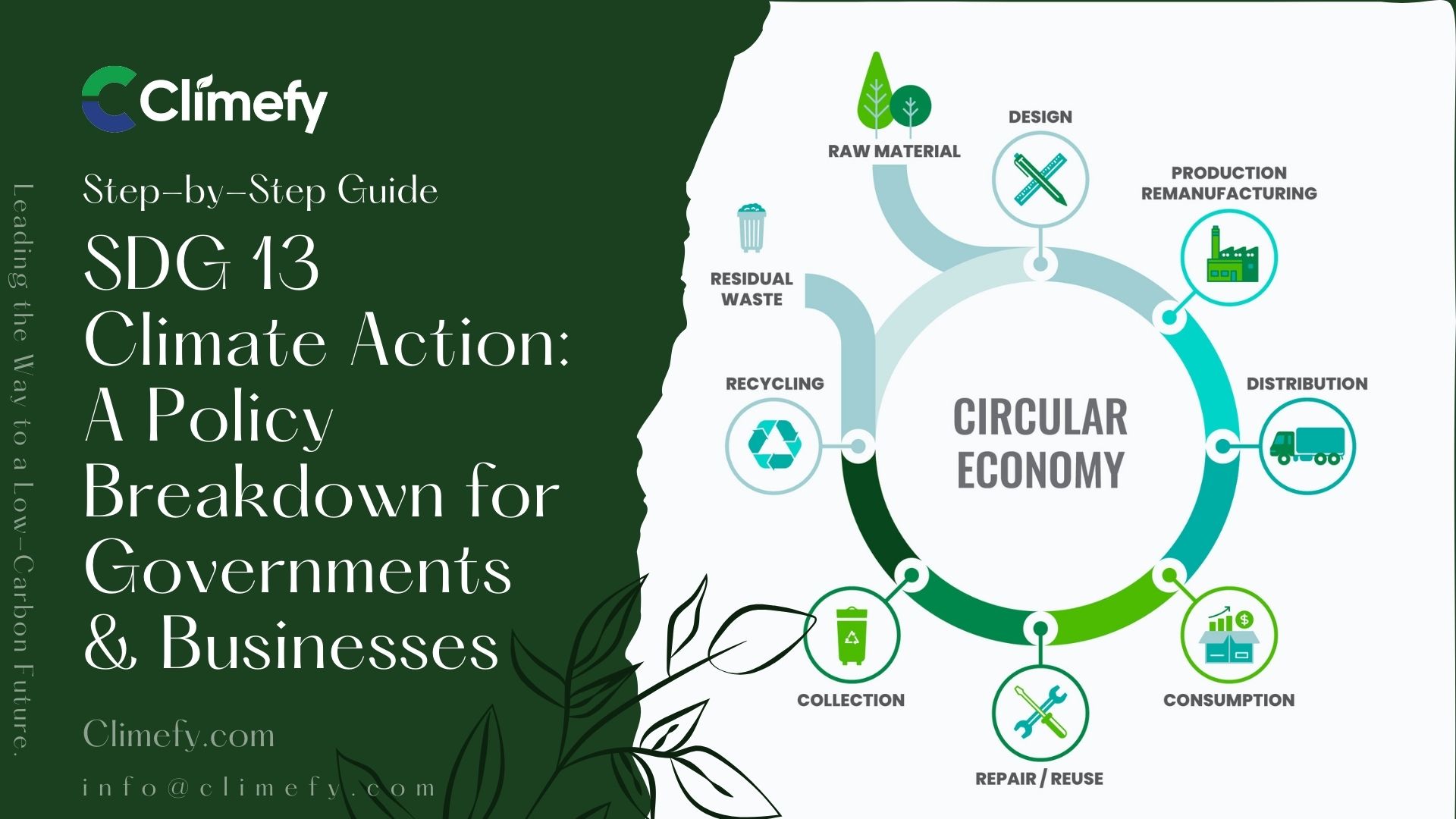
✔ Supply Chain Engagement and Circular Economy Models: For most companies, Scope 3 emissions from the value chain constitute the largest share. Strategies here include:
✔ Climate Risk Assessment and Adaptation: Businesses must conduct scenario analysis to understand how physical risks (floods, droughts) and transition risks (policy changes, market shifts) could affect operations, assets, and profitability. Adaptation involves fortifying facilities, diversifying supply chains, and developing climate-resilient products or services.
✔ Carbon Offsetting and Insetting for Unavoidable Emissions: For emissions that cannot yet be eliminated, high-quality carbon offsets are a critical tool. This involves investing in verified projects that avoid or remove emissions elsewhere, such as reforestation or renewable energy projects. Partnering with an Eco-Friendly Partner like Climefy to source credits from its verified Marketplace ensures environmental integrity and supports sustainable development. Insetting—investing in emission reductions within your own value chain, like supporting sustainable agriculture for raw materials—is another powerful approach.
✔ Transparent Reporting and Stakeholder Engagement: Regularly disclosing progress through platforms like CDP and integrated annual reports builds trust with investors, customers, and regulators. Engaging with Climefy’s Sustainability Academy can upskill teams to effectively manage and communicate these efforts.
Carbon markets and digital technology are two powerful accelerants for scaling climate action from isolated projects to systemic transformation. Carbon markets, both compliance (mandated by government ETS) and voluntary (driven by corporate commitments), create a economic mechanism to funnel finance toward the most cost-effective emission reduction opportunities globally. Digital integration, meanwhile, provides the transparency, automation, and accessibility needed to mainstream carbon management, making it a seamless part of business operations and consumer choices. Together, they democratize and streamline participation in the climate economy.
Voluntary Carbon Market (VCM) Dynamics:
The VCM allows companies and individuals to purchase carbon credits (each representing one metric ton of CO2e reduced or removed) to compensate for their own emissions. For the VCM to drive real climate progress, credit quality is paramount. This is ensured through rigorous standards that validate a project’s additionality (the reduction wouldn’t have happened without the carbon finance), permanence, and avoidance of leakage. The Climefy Verified Carbon Standard (CVCS) exemplifies such a framework, providing comprehensive guidelines to ensure the integrity of carbon projects developed both locally in regions like Pakistan and internationally. Sourcing credits from a curated Marketplace for GHG reduction projects that hosts such verified initiatives is crucial for credible corporate offsetting strategies.
Digital Integration as a Force Multiplier:
Software solutions are breaking down barriers to entry and enabling real-time climate action. Digital Integration Solutions allow businesses to embed carbon tracking and offsetting directly into their customer-facing platforms and internal systems. For instance:
These integrations make climate action simple, immediate, and scalable, turning every transaction into a potential act for the planet. They also provide businesses with valuable data to inform their own reduction strategies. Utilizing a carbon calculator for individuals embedded within a corporate wellness or sustainability portal can also boost employee engagement and climate literacy.
The convergence of robust carbon standards and seamless digital tools creates a trustworthy and efficient ecosystem. This enables capital to flow effectively to projects that not only reduce emissions but also deliver co-benefits like biodiversity protection and community development, thereby fully aligning with the spirit of SDG 13.
No single government, company, or NGO can solve climate change in isolation. SDG 13’s complexity and scale demand unprecedented collaboration across public, private, and civil society sectors. This multi-stakeholder approach leverages diverse expertise, pools resources, shares risks, and aligns efforts to tackle systemic challenges that no entity can address alone. Effective collaboration accelerates innovation, enhances policy effectiveness, and ensures a just transition that leaves no one behind.
✔ Public-Private Partnerships (PPPs): These partnerships are vital for financing and delivering large-scale climate infrastructure. A government might partner with private firms to build a major offshore wind farm, a green hydrogen production facility, or a city-wide smart energy grid, sharing investment, technical know-how, and operational responsibilities.
✔ Industry Alliances and Consortia: Competitors within sectors often collaborate to solve shared climate challenges. Examples include the First Movers Coalition for hard-to-abate industrial sectors or the Climate Group’s RE100 initiative for corporate renewable energy procurement. These alliances create demand signals for green technologies, develop common standards, and advocate for supportive policies.
✔ Finance Sector Engagement: Banks, asset managers, and insurers play a pivotal role through their capital allocation decisions. Initiatives like the Net-Zero Banking Alliance and Climate Action 100+ see financial institutions committing to align their portfolios with net-zero emissions, using their leverage to influence corporate behavior and fund the transition.
✔ Academic and Research Institution Linkages: Universities and think tanks provide the foundational science, technological innovation, and policy analysis that underpin effective action. Collaboration with these institutions ensures that business and government strategies are evidence-based. Resources like the Climefy Sustainability Academy extend this educational bridge, offering practical training for professionals.
✔ Community and Civil Society Engagement: Meaningful climate action must be rooted in and supported by local communities, especially those most vulnerable to impacts. Collaborating with Indigenous groups, local NGOs, and community leaders ensures that projects—from afforestation to renewable energy installations—are socially equitable, culturally appropriate, and garner local support.
✔ International Knowledge and Technology Transfer: Fulfilling the UNFCCC commitment to support developing countries relies on collaboration between nations and organizations in the Global North and South. This includes sharing climate-smart technologies, building local capacity, and supporting projects through mechanisms like the Clean Development Mechanism (CDM). Organizations operating verified standards, such as the Climefy Verified Carbon Standard, facilitate this transfer by enabling high-integrity carbon projects in developing economies.
The synergy created by these collaborative networks is greater than the sum of its parts. They build the trust, shared vision, and collective capability required to implement the interconnected solutions—policy, technology, finance, and behavior change—that SDG 13 demands. For any organization, seeking out and becoming an Eco-Friendly Partner in such coalitions is a powerful amplifier of impact.
Mitigation refers to actions that reduce the emission of greenhouse gases into the atmosphere, thereby addressing the root cause of climate change. Examples include switching to renewable energy or improving energy efficiency. Adaptation involves adjusting to the current and expected effects of climate change to minimize damage. Examples include building sea walls, developing drought-resistant crops, and creating early warning systems for storms. Both are essential pillars of SDG 13 Climate Action.
SMEs can begin by measuring their carbon footprint using a dedicated tool like the Carbon Calculator for Small & Medium Companies. The next steps involve setting a modest reduction target, focusing on quick wins like improving energy efficiency in operations and reducing waste, and then exploring renewable energy options. Engaging with an ESG Consultancy service can provide tailored, affordable guidance. For unavoidable emissions, SMEs can consider purchasing high-quality offsets from a verified Marketplace.
A high-quality carbon credit must represent one tonne of CO2e that is real (actually occurred), additional (the emission reduction would not have happened without the carbon finance), permanent (not reversible, e.g., through forest fire), uniquely claimed (not double-counted), and verified by an independent third party under a rigorous standard. It should also have no significant social or environmental harms. Standards like the Climefy Verified Carbon Standard (CVCS) are designed to ensure these criteria are met.
For many companies, particularly in sectors like consumer goods, finance, and services, Scope 3 emissions (those from the value chain, including purchased goods, business travel, and use of sold products) can account for 70% or more of their total carbon footprint. Ignoring them means missing the largest part of a company’s climate impact and associated risks. Managing Scope 3 emissions is crucial for true climate leadership, comprehensive risk management, and achieving net-zero commitments.
Climate action (SDG 13) is deeply interconnected with all other SDGs. For instance, transitioning to clean energy (SDG 7) improves air quality (SDG 3). Climate-smart agriculture enhances food security (SDG 2) and protects life on land (SDG 15). Investing in resilience protects communities from disasters, reducing poverty (SDG 1) and inequality (SDG 10). Effective climate policy thus creates a powerful positive ripple effect across the entire sustainable development agenda.



![Air Capture Technology and Future [Ultimate Guide]](https://climefy.com/wp-content/uploads/2026/04/Air-Capture-Technology-and-Future-Ultimate-Guide-300x169.jpg)