


Carbon pricing is no longer a niche environmental concept but a fundamental economic and strategic reality reshaping the global business landscape. It is a policy tool designed to reduce greenhouse gas emissions by assigning a financial cost to carbon dioxide (CO2) and other GHG emissions, thereby incentivizing emitters to shift toward cleaner alternatives. For any modern business, understanding carbon pricing is not optional; it is essential for managing future costs, ensuring regulatory compliance, unlocking competitive advantages, and fulfilling corporate social responsibility.
In this definitive guide, you will learn:
Read More:
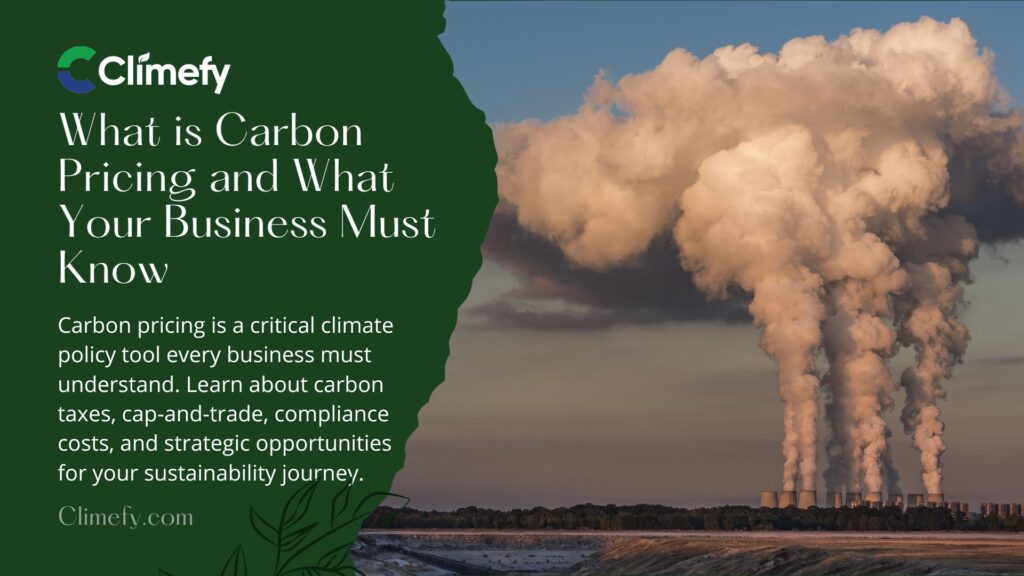
Carbon pricing is an environmental and economic strategy that places a monetary value on the right to emit one metric ton of carbon dioxide equivalent (tCO2e). The fundamental principle is simple: by making polluters pay for their emissions, it creates a powerful financial signal for companies and individuals to seek out lower-carbon alternatives, invest in energy efficiency, and innovate cleaner technologies.
This “polluter pays” principle internalizes the external costs of climate change—such as damage from extreme weather, health impacts, and environmental degradation—that are otherwise borne by society.
The ultimate goal of any carbon pricing policy is to achieve emission reductions in the most cost-effective way for the economy, allowing the market to determine where and how cuts are made.
The concept rests on several key semantic terms and entities:
Why Carbon Pricing is Considered the Most Efficient Tool by Economists:
✔️ Cost-Effective Abatement: It finds the cheapest emission reductions first, minimizing the overall economic cost of climate action.
✔️ Revenue Generation: Governments can reinvest carbon pricing revenue into clean energy, infrastructure, or tax cuts.
✔️ Certainty & Flexibility: It provides a clear price signal while allowing companies the flexibility to choose how to respond.
✔️ Drives Innovation: A consistent price on carbon stimulates long-term investment in low-carbon technologies and processes.
While the goal is unified, the methods vary. Businesses will encounter two primary forms of explicit carbon pricing, along with several implicit and derivative instruments.
A carbon tax is a straightforward, price-based mechanism where the government sets a fixed fee that must be paid for each ton of CO2e emitted. This provides price certainty for businesses, as they know the exact cost of their emissions, but it does not guarantee a specific emission reduction outcome. Companies can decide whether it is cheaper to pay the tax or invest in emission reduction technologies. Jurisdictions like Canada, Singapore, and South Africa have implemented national carbon taxes.
The key characteristics include:
An Emissions Trading System (ETS), or cap-and-trade, is a quantity-based instrument. The government or regulatory body sets a firm cap (absolute limit) on the total amount of GHG that can be emitted by covered sectors. It then issues a corresponding number of allowances (or permits), each representing the right to emit one ton of CO2e. These allowances can be:
This creates a carbon market price driven by supply and demand. If a company reduces its emissions below its allowance holdings, it can sell its surplus. If it exceeds its allowances, it must buy more from the market or face penalties. This system guarantees an environmental outcome (the cap) but leads to price volatility. The European Union ETS (EU ETS) is the world’s largest and most established such system.
Comparison Table: Carbon Tax vs. Cap-and-Trade
| Feature | Carbon Tax | Cap-and-Trade (ETS) |
|---|---|---|
| Core Mechanism | Sets a fixed price per ton of emissions. | Sets a fixed cap on total emissions (quantity). |
| Price Certainty | High. Businesses know the cost. | Low. Price fluctuates with the market. |
| Emission Certainty | Low. Reduction outcome depends on market response. | High. The environmental cap is fixed. |
| Administrative Complexity | Generally lower. | Generally higher, requiring trading infrastructure. |
| Revenue Predictability | High for the government. | Variable, depends on auction design. |
| Primary Business Risk | Operational cost increases. | Compliance cost and market price volatility. |
The global carbon pricing landscape is a complex patchwork of national, regional, and sub-national systems. As of today, over 70 carbon pricing instruments are in operation worldwide, covering about 23% of global GHG emissions. Understanding this mosaic is vital for multinational corporations and businesses in the supply chain.
The EU ETS, launched in 2005, is the world’s first and largest international carbon pricing system. It operates in all EU countries plus Iceland, Liechtenstein, and Norway, covering power generation, energy-intensive industries, and aviation within the EEA. Its key features include:
✔️ A steadily declining emissions cap to meet EU climate targets.
✔️ A significant portion of allowances sold via auctions, with revenue funding climate innovation.
✔️ A Market Stability Reserve (MSR) to manage surplus allowances and support price stability.
✔️ Plans to expand to maritime transport and possibly road transport and buildings.
Parallel to compliance markets, the voluntary carbon market has exploded. Driven by corporate net-zero pledges, companies voluntarily purchase carbon credits to offset emissions they cannot yet eliminate.
This market demands rigorous standards for carbon offset project verification to ensure environmental integrity. Platforms like the Climefy Marketplace are crucial in connecting businesses with high-quality, verified projects, from afforestation to renewable energy, ensuring that voluntary action leads to real climate impact.
The implementation of carbon pricing translates into tangible business impacts across financial, operational, and strategic dimensions. Proactive assessment is the first step toward effective management.
Actionable Steps for Initial Impact Assessment:
✔️ Conduct a Carbon Footprint Analysis: Use a comprehensive tool like the Climefy carbon calculator for businesses to establish a baseline for your Scope 1, 2, and 3 emissions.
✔️ Map Your Exposure: Identify which of your facilities, sectors, and key suppliers fall under existing or proposed carbon pricing jurisdictions.
✔️ Model Cost Scenarios: Run financial models using different carbon price trajectories ($10, $50, $100/tCO2e) to understand potential future cost impacts.
✔️ Benchmark Against Peers: Analyze how competitors in your sector are responding to carbon pricing and disclosing climate risks.
A reactive approach to carbon pricing is a liability. A proactive, strategic approach transforms it into an opportunity for resilience, innovation, and market leadership. Here is a structured response framework.
You must begin with accurate measurement. This involves:
After measurement comes action on reduction.
For emissions that cannot yet be eliminated, high-quality compensation is essential.
The trajectory is clear: carbon pricing will become more widespread, prices will rise, and systems will become more interconnected. The Net Zero commitments by major economies and corporations effectively mandate this evolution.
Key Future Trends:
✔️ Higher Carbon Prices: To align with the Paris Agreement goals, most expert analyses suggest carbon prices need to reach levels well above $100/tCO2e by 2030.
✔️ Expansion of Coverage: More sectors (aviation, maritime, buildings) and more greenhouse gases (particularly methane) will be incorporated into systems.
✔️ International Linkage: Separate carbon markets (e.g., EU ETS and Switzerland) may link to create larger, more liquid, and stable markets.
✔️ Border Carbon Adjustments (BCAs): Instruments like the EU’s Carbon Border Adjustment Mechanism (CBAM) will level the playing field by imposing a carbon price on imports from countries with weaker climate policies, making global supply chain decarbonization imperative.
✔️ Integration with ESG and Finance: Carbon pricing risk is a core component of ESG (Environmental, Social, and Governance) ratings and is increasingly influencing credit ratings, loan conditions, and investment decisions.
Start your journey today. The cost of inaction will far exceed the cost of early, strategic adaptation. Begin by measuring your footprint with precision using advanced tools like those from Climefy, develop a science-based reduction plan, and integrate a carbon price into your financial planning.
Embrace this not as a compliance burden, but as a catalyst for innovation, efficiency, and long-term value creation in a decarbonizing global economy.
For comprehensive support—from initial footprint calculation to carbon offset issuance & certification, ESG consultancy, and achieving your net zero journey—explore the integrated solutions available at Climefy.
Carbon pricing is a market-based strategy to lower greenhouse gas emissions by putting a price on carbon pollution. This makes emitting CO2 more expensive, encouraging businesses and individuals to use less fossil fuels and invest in cleaner energy and technologies.
A carbon tax sets a fixed price on carbon but lets the emission quantity vary. A cap-and-trade system (or ETS) sets a fixed cap on total emissions and lets the market determine the price of carbon allowances. One offers price certainty; the other offers environmental certainty.
Carbon pricing can lead to higher prices for goods and services that are carbon-intensive to produce, such as gasoline, electricity from fossil fuels, and certain materials. However, well-designed systems often recycle the revenue back to citizens through tax rebates or dividends, or invest it in public transit and clean energy, which can offset costs for lower-income households.
Yes, when implemented effectively with a sufficiently high price, it is one of the most economically efficient tools for reducing emissions. Evidence from systems like the EU ETS shows it has successfully driven emission reductions in covered sectors, primarily by shifting power generation from coal to gas and renewables.
Carbon offsets are credits from projects that reduce or remove emissions elsewhere (e.g., planting trees, building wind farms). In a compliance carbon market, they may be allowed for limited use to meet obligations. In the voluntary market, companies buy them to compensate for emissions they cannot eliminate, supporting their net-zero claims. Quality and verification are critical.


![Air Capture Technology and Future [Ultimate Guide]](https://climefy.com/wp-content/uploads/2026/04/Air-Capture-Technology-and-Future-Ultimate-Guide-300x169.jpg)