


Sustainable mobility is no longer a distant ideal but an urgent necessity. Green transport encompasses all modes of travel that reduce environmental impact through lower emissions, improved efficiency, and renewable energy integration, offering a viable pathway to combat climate change while enhancing quality of life.
What you will learn from this guide:
Read More:
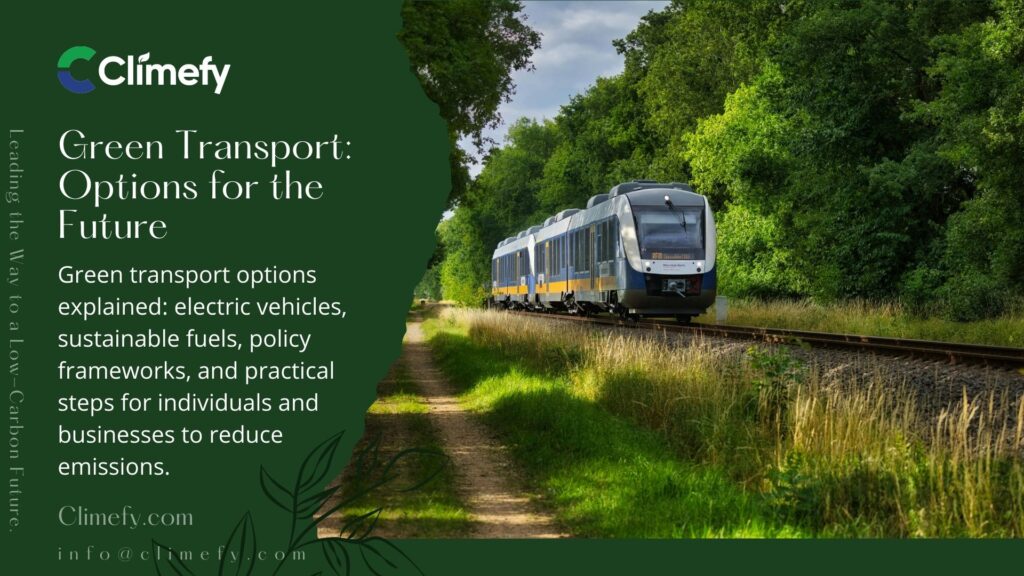
Transportation accounts for approximately 23% of global energy-related CO₂ emissions, making it one of the largest and fastest-growing drivers of climate change. Green transport, also known as sustainable transport or eco-friendly mobility, refers to any means of moving people and goods that minimizes environmental harm while promoting social equity and economic viability.
Green transport encompasses all mobility solutions designed to reduce carbon footprints, improve air quality, and decrease dependence on fossil fuels. This includes electric vehicles, public transit systems, active travel options like walking and cycling, and the infrastructure that supports them.
The concept extends beyond just vehicles themselves to encompass the entire mobility ecosystem. Sustainable transport considers the full lifecycle impacts from manufacturing to disposal, the energy sources powering movement, and the urban planning decisions that determine how far people need to travel in the first place.
To align with the Paris Agreement targets, the transport sector must cut emissions by approximately 25% by 2030. Without rapid transformation, transport emissions could undermine progress made in other sectors.
The urgency stems from transport’s unique position as both a major emitter and a sector where emissions continue growing rapidly. Unlike electricity generation, where renewables are displacing coal, transport remains heavily dependent on petroleum products. Decarbonizing transport is therefore essential for achieving net-zero emissions by mid-century.
Sustainable transport solutions generally fall into several interconnected categories. Clean vehicle technologies include battery electric vehicles, hydrogen fuel cell vehicles, and hybrids that reduce or eliminate tailpipe emissions. Alternative fuels such as biofuels, biomethane, and synthetic fuels provide drop-in replacements for fossil fuels in existing vehicles.
Active travel encompasses walking and cycling, producing zero emissions while delivering significant health benefits. Shared mobility includes public transport, ride-sharing, and micro-mobility services that maximize efficiency through higher occupancy rates. Finally, modal shift strategies encourage moving freight and passengers from high-carbon to low-carbon modes, such as from private cars to trains or from trucks to ships.
Electric vehicles have emerged as the most visible symbol of the transport revolution, with global investment in electrified transport reaching unprecedented levels. The transition to electric mobility represents a fundamental shift away from internal combustion engines that have dominated for over a century.
Battery electric vehicles (BEVs) store electricity in rechargeable battery packs, using one or more electric motors to drive the wheels. Unlike conventional vehicles, they produce zero tailpipe emissions and operate much more efficiently, converting over 77% of electrical energy from the grid to power at the wheels compared to only 12-30% for gasoline vehicles.
The heart of any EV is its traction battery, typically using lithium-ion chemistry similar to consumer electronics but scaled dramatically. These batteries store direct current electricity, which powers the motor through an inverter that converts it to alternating current. Regenerative braking captures energy normally lost as heat during deceleration, feeding it back into the battery.
✅ Zero tailpipe emissions improve local air quality
✅ Much lower operating costs per kilometer compared to gasoline
✅ Significantly fewer moving parts reduce maintenance needs
✅ Quiet operation reduces noise pollution in urban areas
✅ Potential to run on 100% renewable energy
The electric vehicle landscape has diversified considerably beyond early passenger car offerings. Battery electric vehicles run solely on electricity, requiring charging from the grid. Plug-in hybrid electric vehicles combine an electric motor with a conventional engine, offering limited electric range backed by gasoline for longer trips.
Fuel cell electric vehicles generate electricity onboard through a chemical reaction between hydrogen and oxygen, emitting only water vapor. These are particularly suited for applications requiring rapid refueling and long ranges, such as heavy trucking and buses.
In the two-wheeler segment, electric scooters and motorcycles are transforming mobility across Asia and increasingly worldwide. Electric bicycles, technically pedelecs with motor assistance, have become one of the fastest-growing transport modes globally.
While EVs eliminate tailpipe emissions, their production carries environmental footprints that deserve honest assessment. Battery manufacturing is energy-intensive and requires raw materials including lithium, cobalt, and nickel, whose extraction can have significant environmental and social impacts.
However, lifecycle analyses consistently show that over their entire lifetime, EVs produce substantially lower emissions than conventional vehicles. The break-even point varies by grid carbon intensity but typically occurs within two to three years of driving in most regions. As battery technology improves and manufacturing scales, production emissions continue declining.
Climefy helps organizations accurately assess the full lifecycle impacts of fleet electrification through comprehensive carbon accounting tools. Our carbon calculator for large organizations enables detailed analysis of Scope 3 emissions associated with vehicle manufacturing, helping businesses make informed decisions about their transition strategies.
The success of electric mobility depends critically on accessible, reliable charging infrastructure. Unlike gasoline refueling, which occurs at dedicated stations, EV charging happens across multiple locations and timeframes, requiring new approaches to energy management.
Charging infrastructure is typically categorized by power levels and charging speeds. Level 1 charging uses standard household outlets, adding about 5-8 kilometers of range per hour, suitable for overnight charging at home. Level 2 charging operates at 240 volts, common in homes with dedicated equipment and public locations, adding 25-50 kilometers per hour.
DC fast charging, also known as Level 3, delivers high-power direct current directly to the battery, adding 100-300 kilometers in 20-30 minutes. These are essential for long-distance travel and commercial applications. Ultra-fast chargers exceeding 350 kW are now deploying, capable of adding significant range in minutes rather than hours.
✅ Home charging provides convenience and lowest electricity rates
✅ Workplace charging enables daytime top-ups using solar generation
✅ Destination charging at stores, restaurants, and hotels utilizes dwell time
✅ Corridor fast charging enables long-distance travel
✅ Depot charging serves fleets returning to centralized locations
Smart charging refers to EV charging that can be controlled or influenced based on grid conditions, electricity prices, or renewable energy availability. Rather than simply drawing maximum power whenever plugged in, smart chargers optimize charging timing and power levels.
This capability transforms EVs from simple loads into grid assets. Vehicles can charge when renewable generation peaks, typically midday for solar, or during overnight hours when demand is low and wind power often abundant. Some systems enable vehicle-to-grid functionality, where EVs can discharge back to the grid during peak demand periods, providing valuable grid services.
The environmental benefits of electric vehicles scale with grid cleanliness. Charging from coal-heavy grids still reduces emissions compared to gasoline but delivers smaller climate benefits than charging from renewable sources.
Many EV owners and organizations are pairing charging with onsite renewable generation. Solar panels at homes and businesses can directly power vehicle charging, effectively running vehicles on sunshine. Some charging networks now offer guarantees that electricity sold comes from renewable sources through renewable energy certificates or direct power purchase agreements.
Climefy’s digital integration solutions enable businesses to incorporate real-time carbon tracking into their charging operations, helping optimize charging times based on grid carbon intensity and renewable availability.
While passenger electric vehicles capture most attention, comprehensive transport decarbonization requires transforming every mode, from two-wheelers to ships and aircraft. Each mode presents unique challenges and opportunities.
Buses represent one of the most successful applications of electric mobility to date. Cities worldwide are electrifying bus fleets, with Shenzhen, China completing conversion of its entire 16,000-bus fleet years ago, reducing CO₂ emissions by hundreds of thousands of tons annually.
Electric buses offer particular advantages for urban transit. Their predictable routes enable precise range planning, central depots simplify charging infrastructure deployment, and their high utilization maximizes emission reductions per vehicle. Battery costs have fallen sufficiently that total cost of ownership for electric buses now often undercuts diesel alternatives, especially when considering fuel and maintenance savings.
The TransJakarta BRT system demonstrates how electrification combines with high-quality bus rapid transit to move over one million passengers daily while cutting commute times by 30%, delivering both climate and social benefits.
Shipping carries about 90% of global trade and has proven difficult to decarbonize due to long voyage distances, limited space for energy storage, and the high energy density of marine fuels. However, multiple pathways are emerging.
Hydrogen fuel cells are powering an increasing number of vessels, particularly ferries and short-sea ships where refueling infrastructure can be concentrated. Wind-assisted propulsion, using modern automated sails and kites, is returning to commercial shipping, reducing fuel consumption on suitable routes. Battery-electric ferries now operate across Scandinavia and increasingly worldwide for shorter crossings.
Green methanol and ammonia produced from renewable hydrogen show promise as future marine fuels, offering higher energy density than hydrogen while potentially using existing fuel handling infrastructure.
Aviation presents perhaps the greatest decarbonization challenge due to extreme weight constraints and safety requirements. However, progress is accelerating across multiple fronts.
Sustainable aviation fuels derived from waste oils, agricultural residues, or synthesized from renewable hydrogen can reduce lifecycle emissions by up to 80% while working within existing aircraft and infrastructure. Electric aircraft are entering service for short routes and flight training, with several manufacturers developing commuter aircraft for routes under 500 kilometers.
Hydrogen combustion and fuel cells are being pursued for longer ranges, with aircraft manufacturers targeting entry into service within the next decade. The International Energy Agency has called for quadrupling sustainable fuel production, recognizing aviation’s need for high-energy-density solutions.
Rail is already the most energy-efficient land transport mode per passenger-kilometer or ton-kilometer, particularly when electrified. Expanding and improving rail services enables modal shift from higher-carbon alternatives.
Electrification of remaining diesel lines continues globally, with battery and hydrogen trains filling gaps where full electrification isn’t economically justified. High-speed rail provides competitive alternatives to short-haul aviation on many corridors, offering lower emissions and often comparable journey times when airport access times are considered.
Urban rail systems including metros, light rail, and trams provide high-capacity mobility that shapes sustainable city development. The Paris Grand Express Metro expansion exemplifies how rail investment can transform regional connectivity while supporting denser, more walkable communities around stations.
Not all sustainable transport requires advanced technology. Active travel and micromobility offer some of the most accessible, affordable, and immediately impactful options for reducing transport emissions.
Walking and cycling produce zero emissions, require minimal infrastructure investment compared to roads, and deliver substantial public health benefits through increased physical activity. Yet they remain underutilized in many regions due to safety concerns and inadequate facilities.
The ecological footprint of active travel approaches zero, while the space efficiency is remarkable. A single car lane can move about 2,000 people per hour, while a cycle lane of similar width can move 7,000 or more. For short urban trips under five kilometers, cycling is often the fastest door-to-door mode when congestion and parking are considered.
Cities investing in high-quality walking and cycling networks see rapid mode shift. Seville built 80 kilometers of protected cycle lanes and saw cycling mode share rise from 0.5% to 6% in just a few years. Similar transformations are occurring across European and increasingly global cities.
Micromobility encompasses lightweight vehicles including bicycles, e-bikes, electric scooters, and similar devices typically weighing under 500 kilograms. Shared micromobility services have exploded globally, providing flexible first-mile and last-mile connections to public transport.
E-bikes deserve particular attention as they dramatically expand the geographic range and demographic appeal of cycling. Hills, headwinds, and sweat become manageable, enabling cycling for commuting, errands, and trips that would otherwise require cars. E-bike sales now exceed electric car sales in many markets, with profound implications for urban mobility patterns.
✅ Fills gaps in public transport networks
✅ Reduces car dependency for short trips
✅ Requires minimal parking space
✅ Provides affordable mobility options
✅ Scales rapidly through shared services
Quality infrastructure determines whether people choose active travel. Protected cycle tracks physically separated from motor traffic significantly increase cycling rates while improving safety for all road users. Wide, well-maintained footpaths encourage walking and accommodate diverse users including those with mobility limitations.
Bicycle parking facilities at destinations and transit stations enable multi-modal journeys. Wayfinding systems help users navigate comfortable routes. Traffic calming measures reduce vehicle speeds, making streets safer and more pleasant for active travel.
The “Four-Wells Rural Roads” initiative demonstrates how even rural areas benefit from active travel investments. By ensuring roads are well built, managed, maintained, and used, rural communities gain safer access for walking and cycling alongside motorized options.
Technology alone cannot deliver sustainable transport. Supportive policies, significant investment, and institutional coordination are essential to accelerate the transition and ensure equitable outcomes.
Effective policy packages combine carrots and sticks. Purchase incentives reduce the upfront cost barrier for clean vehicles, making them accessible to more buyers. Congestion charging and low-emission zones internalize the external costs of driving polluting vehicles in urban areas.
Fuel economy standards and zero-emission vehicle mandates push manufacturers to improve efficiency and produce cleaner models. Parking policies that price or restrict car storage encourage mode shift while generating revenue for sustainable transport investments.
Public transport investment and service improvements provide attractive alternatives to driving. The German €9 ticket experiment demonstrated that deeply discounted fares can dramatically increase ridership, cutting emissions while improving mobility access.
The United Nations has proclaimed 2026-2035 as the Decade of Sustainable Transport, recognizing transport’s central role in achieving the Sustainable Development Goals. This framework elevates transport on the global agenda and encourages coordinated action across countries and sectors.
The Decade emphasizes three priorities: equity in transport ensuring affordable mobility for all, sustainable systems integrating transport with energy and urban planning, and evidence-based planning using robust data. These priorities reflect growing recognition that transport transformation must serve social goals alongside environmental ones.
Current investment in clean transport, while growing rapidly, remains insufficient. BloombergNEF estimates that current investment represents only about 37% of what is required to align with net-zero scenarios.
The gap is particularly acute in low- and middle-income countries, which receive less than 3% of climate finance for transport despite hosting the fastest-growing vehicle fleets. Redirecting investment toward these regions is essential to avoid locking in high-carbon infrastructure for decades.
Public-private partnerships are proving effective at scaling investment. Initiatives in India, Mexico, and Brazil are deploying tens of thousands of electric vehicles and hundreds of megawatts of renewable capacity through coordinated business and government action. These models demonstrate how collaboration can de-risk investment and accelerate deployment.
Climefy’s carbon offset registry and marketplace connect project developers with financing for verified emission reductions, helping channel investment toward high-quality transport decarbonization projects globally.
The transport revolution continues accelerating, with emerging technologies promising to further transform mobility in coming decades. Understanding these developments helps businesses and individuals prepare for coming changes.
Hyperloop concepts propose passenger pods traveling through low-pressure tubes at speeds exceeding 1,000 kilometers per hour, potentially revolutionizing intercity connectivity. By eliminating air resistance, such systems could achieve aircraft speeds with fraction of the energy consumption.
While full-scale hyperloop remains developmental with significant engineering challenges, the underlying principle of reducing drag through partial vacuum has merit. Several test tracks exist, and proponents envision networks connecting major city pairs within decades.
More immediately, high-speed rail continues expanding globally, providing proven technology for fast, efficient intercity travel. Maglev trains using magnetic levitation already exceed 600 kilometers per hour in commercial operation, offering another pathway to ultra-fast surface transport.
Autonomous vehicles present both opportunities and risks for sustainability. Optimistically, self-driving technology could enable more efficient driving patterns, platooning that reduces aerodynamic drag, and seamless integration with public transport. Shared autonomous fleets could reduce private vehicle ownership while increasing utilization rates.
Pessimistically, autonomous vehicles could induce additional travel by making driving time productive or comfortable, potentially increasing rather than decreasing emissions. Without strong policy guidance, the technology could reinforce car-dependent sprawl rather than supporting compact, walkable communities.
The outcome depends on whether autonomous vehicles are deployed as shared services integrated with public transport or as private luxury vehicles, and on complementary policies guiding urban development and pricing road use appropriately.
Battery technology continues evolving rapidly, with several promising developments on the horizon. Solid-state batteries replacing liquid electrolytes with solid materials promise higher energy density, faster charging, and improved safety. Several automakers and battery manufacturers target commercial production within years.
Sodium-ion batteries offer potential for lower-cost, more sustainable energy storage using abundant materials rather than lithium. While energy density is lower, they may prove suitable for applications where weight matters less, such as stationary storage and some commercial vehicles.
Battery recycling technologies are advancing, enabling recovery of valuable materials and reducing the need for new mining. Closed-loop systems where old vehicle batteries become raw material for new ones could dramatically reduce the environmental footprint of electrification.
Digital technologies are transforming transport operations and user experiences. Mobility-as-a-service platforms integrate trip planning, booking, and payment across multiple modes, making it easy to combine walking, bike-sharing, ride-hailing, and public transport in single journeys.
Real-time data enables dynamic routing and demand-responsive transport, particularly valuable in lower-density areas where fixed-route services struggle. Digital mapping tools help planners understand mobility needs of vulnerable populations, enabling more inclusive service design.
Data-sharing platforms in India and elsewhere enable evidence-based charging infrastructure planning by collecting fleet operational data. Such approaches have achieved 70% reductions in per-delivery charging time and 13% fuel cost savings for fleet operators.
Achieving sustainable transport requires action at all levels. Businesses and individuals each have crucial roles in accelerating the transition through their choices and advocacy.
Corporate action on transport decarbonization is accelerating, with many companies committing to electric fleets and sustainable logistics. The Zero Emission Vehicle Emerging Markets Initiative demonstrates how businesses collaborate to scale deployment across regions, targeting over 26,000 electric vehicles in India, Mexico, and Brazil alone.
Companies should begin by measuring their transport emissions comprehensively, including Scope 3 emissions from supply chains and employee commuting. Climefy’s carbon calculator for small and medium companies and large organizations enables detailed emissions tracking across all scopes, providing the foundation for reduction strategies.
✅ Conduct comprehensive fleet emissions assessment
✅ Right-size vehicles to actual needs
✅ Optimize routes to minimize distance traveled
✅ Transition suitable vehicles to electric alternatives
✅ Engage suppliers on their transport emissions
✅ Support employee sustainable commuting through incentives
Once emissions are understood, companies can set reduction targets aligned with climate science and develop implementation roadmaps. Many find that electrification reduces total operating costs over vehicle lifetimes while delivering sustainability benefits.
Organizations can leverage their purchasing power to accelerate transport decarbonization beyond their direct operations. Specifying low-emission delivery requirements for suppliers sends market signals that encourage innovation and investment.
Sustainable freight procurement includes requiring carriers to report emissions, prioritizing those using cleaner vehicles, and consolidating shipments to improve efficiency. Some companies are aggregating demand to create predictable signals that de-risk charging infrastructure investment along key freight corridors.
For employee travel, sustainable travel policies can prioritize rail over air for suitable journeys, encourage virtual meetings to reduce travel needs, and provide incentives for low-emission options when travel is necessary.
Individual choices collectively shape transport systems and markets. Transportation is often the largest component of personal carbon footprints, making individual action meaningful.
Choosing active travel for short trips reduces emissions while improving health. Using public transport for longer journeys reduces per-person emissions compared to driving alone. When purchasing vehicles, considering electric or efficient options sends market signals to manufacturers.
Beyond personal travel, individuals can advocate for sustainable transport investments in their communities. Supporting safe cycling infrastructure, better public transport, and walkable neighborhoods creates conditions enabling broader mode shift.
Climefy’s carbon calculator for individuals helps people understand their personal transport footprint and identify the most impactful reduction opportunities tailored to their circumstances.
Despite compelling benefits, significant barriers slow sustainable transport adoption. Understanding these obstacles enables more effective strategies to overcome them.
Range anxiety, despite declining relevance as battery ranges increase and charging infrastructure expands, remains a psychological barrier for many potential buyers. Addressing this requires continued infrastructure deployment and consumer education about actual usage patterns.
Upfront cost remains higher for electric vehicles than comparable conventional models, though total cost of ownership often favors EVs when fuel and maintenance savings are considered. Purchase incentives help bridge this gap, and continued battery cost declines will eventually eliminate it.
Charging access varies significantly, with apartment dwellers and on-street parkers facing greater challenges than those with dedicated parking. Policy solutions including right-to-charge laws and public charging deployment are essential for equitable access.
Transport electrification must benefit all communities, not just affluent early adopters. Low-income households spend higher proportions of income on transport and often face the greatest exposure to traffic pollution.
Social leasing programs in France and Italy make electric vehicles accessible to lower-income households through affordable monthly payments. Free or deeply discounted public transport in cities from Tallinn to Luxembourg improves mobility access while reducing emissions.
Transport workers, including those in manufacturing and driving occupations, need support through transitions. Just transition planning ensures workers gain new skills and opportunities rather than bearing transition costs.
Charging infrastructure deployment must accelerate dramatically to support growing electric vehicle fleets. This is particularly urgent for heavy trucking, where megawatt-scale charging along key freight corridors requires coordinated planning and investment.
Grid capacity must expand to serve transport electrification while maintaining reliability. Smart charging and vehicle-grid integration help manage loads, but distribution upgrades will be necessary in many areas.
Walking and cycling infrastructure remains inadequate in most communities, limiting active travel options. Completing networks of protected facilities would unlock significant mode shift potential.
The transition to green transport is both necessary and achievable. Technologies exist today to dramatically reduce transport emissions while improving mobility access and quality of life. The challenge lies in scaling deployment, ensuring equitable access, and maintaining momentum through political and economic cycles.
Success requires coordinated action from governments setting clear policies and investing in infrastructure, businesses transforming fleets and operations, and individuals making sustainable choices. The UN Decade of Sustainable Transport provides a framework for this collaboration.
Climefy stands ready to support organizations throughout their sustainability journeys. From accurate carbon measurement through our calculator tools to offsetting remaining emissions via our verified marketplace, we provide the comprehensive solutions needed to achieve transport decarbonization goals. Our ESG consultancy helps businesses navigate the complexities of transition, while our academy offers education for those seeking deeper understanding.
The transport systems we build today will shape communities and climate for decades. By choosing sustainable options now, we create cleaner air, quieter streets, more accessible communities, and a stable climate for future generations. The road ahead is clear; the time to travel it is now.
Green transport specifically focuses on environmental impacts, particularly emissions and resource use. Sustainable transport encompasses environmental concerns while also addressing social equity and economic viability, ensuring mobility systems work for all community members across generations.
Electric vehicles eliminate tailpipe emissions entirely. Well-to-wheel emissions depend on electricity source, but even with current average grids, EVs reduce lifecycle emissions by 50-70% compared to gasoline vehicles. This improves as grids become cleaner, with potential for near-zero emissions when charged from renewables.
Each technology suits different applications. Battery electric vehicles offer higher efficiency and lower operating costs for most passenger and light-duty applications where overnight charging is available. Hydrogen fuel cells excel for heavy-duty, long-range applications requiring rapid refueling, such as trucking, buses, and potentially trains and marine vessels.
For short distances, walking and cycling have minimal environmental impact while providing health benefits. For longer journeys, trains typically offer lowest emissions per passenger-kilometer. When driving is necessary, electric vehicles charged from renewable sources represent the cleanest option, especially with multiple passengers sharing the trip.
Begin by measuring current transport emissions using comprehensive tools like Climefy’s carbon calculators. Identify quick wins such as route optimization and driver training, then develop phased plans for fleet electrification. Engage employees and suppliers in the journey, and consider verified carbon offsets for remaining unavoidable emissions through our marketplace.



![Air Capture Technology and Future [Ultimate Guide]](https://climefy.com/wp-content/uploads/2026/04/Air-Capture-Technology-and-Future-Ultimate-Guide-300x169.jpg)